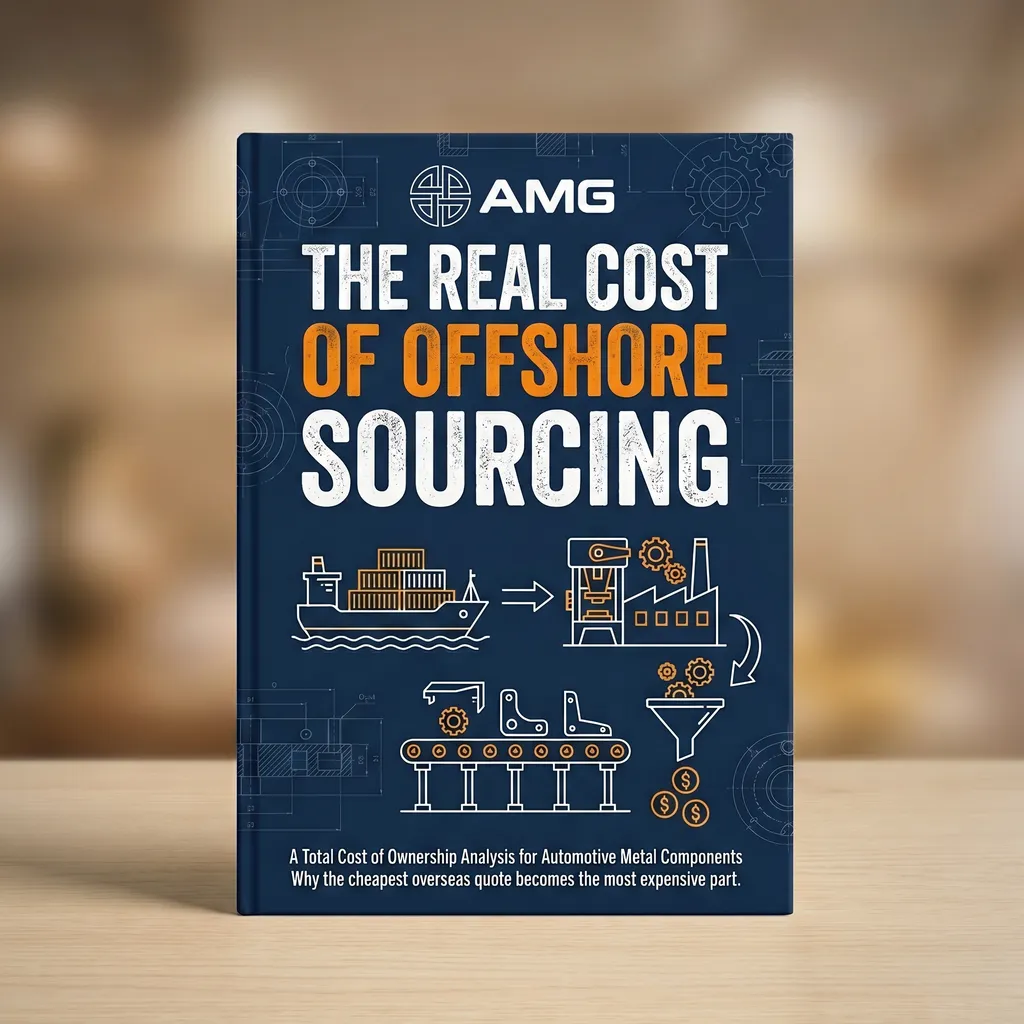

We Re-Checked Every Tariff Claim in Our Sourcing Whitepaper
By Jon Bickel
Published on: 8/8/2026
Updated September 2026. Four corrections and one new section since this first published. July 20 brought four proclamations rather than two, the Section 338 duties took effect August 22, the Section 232 carve-out ended for most covered goods on September 15, and the motor-vehicle proclamation doesn’t tax motor vehicles. Details below.
Four tariff proclamations came out of Washington on July 20. When your company has published a whitepaper full of tariff rates, thresholds, and effective dates, news like that comes with homework, so we spent the past week going back through our domestic vs. offshore sourcing whitepaper claim by claim, checking each one against the Federal Register.
I want to share what we found, partly because the new proclamations matter to anyone sourcing automotive metal components, and partly because I think publishing cost math obligates you to tell readers when the ground shifts underneath it. So this post covers both: what held up, and what changed.
What we checked, and what held
The whitepaper’s argument rests on the tariff structure that took effect April 6, 2026. Under that structure, Section 232 duties on covered steel, aluminum, and copper articles apply to the full customs value of the imported part, at 50 percent for products under Annex I-A and 25 percent under Annex I-B. Before April, a $10 bracket with $3 of covered metal content was tariffed on the $3. Since April, it’s been tariffed on the whole $10, which is the change that pried piece price and total cost apart for so many offshore parts.
The June 8 refinement layered on a 10 percent rate for parts whose metal was melted and poured (steel) or smelted and cast (aluminum) in the United States, and lowered the qualifying U.S.-content threshold from 95 to 85 percent by weight.
All of it is still in effect, and nothing between August and the middle of September touched it. The 50/25 full-value structure, the 10 percent U.S.-melt rate, the 85 percent threshold, the exclusion of Chapters 72, 73, 74, and 76 from the under-15-percent metal-content carve-out, the temporary machinery relief running through December 31, 2027. We checked each against the Federal Register and the July 21 tariff trackers the trade bar maintains, and nothing in the paper needs a correction.
The July 20 proclamations sit on top of that structure, and all four push in the same direction the paper points.
Section 338, and what it actually taxes
The bigger headline is Section 338. On July 20 the administration issued three proclamations under it, answering Canada’s tariff treatment of U.S. motor vehicles, dairy, and alcoholic beverages. These are the first tariffs ever imposed under Section 338 of the Tariff Act of 1930, a statute that sat unused for over ninety years.
The duties were written to start August 19. On August 18 a follow-up proclamation suspended that date for three days while Canada signaled it would drop the measures at issue, Canada reneged on the 21st, the suspension lapsed, and the duties went live at 12:01 a.m. eastern on August 22.
I have a correction to make on the version of this post I published in August, and it’s the kind of wrong that costs a buyer money. I described the motor-vehicle proclamation as putting 50 percent duties on Canadian-built vehicles. It doesn’t. The proclamation is named for the Canadian policy it answers, not for what it taxes. Its Annex II is a 441-line basket of ordinary Canadian goods running from cut flowers and essential oils through plywood, paper, hand tools, and toys, and the only Chapter 87 line anywhere on it was motorcycles over 800cc. The September 15 revision added golf carts and all-terrain vehicles, and that’s still the whole vehicle list. No cars, no light trucks, no 8708 auto parts.
Two things I wrote about the duty do hold. USMCA origin doesn’t exempt a covered product, so qualifying under the trade agreement offers no protection here, and the duties have no built-in expiration date.
The third has been overtaken. When the duties went live in August, articles already carrying Section 232 duties were carved out of Section 338 entirely, so a Canadian-sourced metal part got tariffed under one regime at a time. A proclamation signed September 8 rewrote that. The Section 338 duties now apply in addition to Section 232 duties, and CBP’s implementing list narrows the old zero-rate carve-out to goods on the dairy schedule. Everything on the motor-vehicle schedule lost it on September 15.
The same proclamation went further. It added 76 tariff lines to the motor-vehicle schedule, and twelve of those are metal articles that Section 232 already taxes: aluminum bars, rods and profiles under 7604, aluminum tubes and pipes under 7608, and iron and steel structures and parts of structures under 7308.90. Base-metal fittings under 8308 and welding electrodes and cored wire under 8311 came in the same batch. Buy any of that from a Canadian supplier and as of September 15 it carries 50 percent under Section 338 stacked on whatever Section 232 already charges, with nothing in the schedule zeroing it out.
Ordinary stampings and weldments classified in 7326.90, and vehicle parts in 8708, are absent from the schedule today, so most of what we quote against is untouched so far. What changed is the structural reason to expect that to last. The protection used to be a rule written into the proclamation itself. Now it’s a rate on a line in Chapter 99, and a line gets moved by proclamation or by a CBP notice on a Friday afternoon. Pull the current list, check your part numbers against it, and put a recurring reminder on your calendar to check it again.
A discount for building American smelting capacity
The fourth July 20 proclamation drew less coverage but says just as much about where policy is headed. It created an incentive program for primary aluminum: a company with a Commerce-approved commitment to build, refurbish, or expand a U.S. primary aluminum facility, with construction started by January 20, 2029, can import primary aluminum at half the Section 232 rate that would otherwise apply, in quantities tied to the planned facility’s output.
The proclamation left every existing rate in place and redrew the shape of the schedule instead. Foreign metal pays 50 percent, metal melted and poured in America pays 10, and a part actually made here pays nothing. Now a company building the capacity to produce American metal gets its imports at half rate while construction proceeds. Every revision since April has widened the advantage of domestic content rather than trimming it. A sourcing strategy that assumes these tariffs fade is betting against the whole run of them.
Update, September 2026
I said at the top that we’d keep re-verifying this. This is the September pass, and the escalation kept going while the details stayed narrower than the headlines around them.
Five more proclamations came out on September 8. Two modified the scope of the Section 338 schedules, which is the September 15 change I folded into the section above. The other three reach for the other half of Section 338 and bar covered Canadian products from importation into the United States entirely, effective 12:01 a.m. eastern on September 29. Read the annexes before you panic, though. The motor-vehicle annex is one line, motorcycles over 800cc, and goods that shipped before the 29th but haven’t been entered for consumption stay at the 50 percent duty rather than getting turned away at the dock. The mechanism matters more than this year’s list, because a duty is a price and a ban is a wall, and the same authority that closed the border to one motorcycle line can be pointed at a longer one.
Canada answered on its own schedule. Finance Canada published a counter-tariff list on August 25 and brought it into force September 8, with surtaxes of 15, 25, or 50 percent on $27.6 billion of U.S. goods, described in Ottawa’s own words as dollar for dollar, rate for rate. Steel and aluminum products that had been carrying a 25 percent Canadian counter-tariff moved up to 50. If you ship finished assemblies or service parts north, your landed cost into Canada moved on September 8, and that’s a conversation to have with whoever owns your Canadian accounts.
Underneath all of it sits the USMCA question, which is easy to get wrong in both directions. At the July 1 joint review, USTR said the United States did not agree to renew the agreement in its current form and that the agreement is therefore not renewed. It has not lapsed. The same statement says the agreement remains in force pending resolution or termination, and preferences and rules of origin are operating normally today. The assumption that’s over is that the framework rolls forward on its own for another sixteen years. Plan on it being reviewed every year, and write your long-term agreements knowing that.
One more worth watching, and I’m going to be careful with the word proposed. On August 6 the Bureau of Industry and Security asked for public comment on pulling 14 more derivative articles into the Section 232 duties on steel, aluminum, and copper. The list reaches trailers and semi-trailers of several kinds, parts of heat exchange units, parts of certain hydraulic engines and motors, certain electric conductor cables, fire extinguishers, parts of welding machines, floor safes, and a few others. Comments closed August 27. No final determination has been published as of today, so none of it binds anyone yet. If it does go final, a set of parts that nobody currently treats as a Section 232 article starts carrying the full-value duty, and the comparison on those parts changes the day it publishes. Worth knowing which of your part numbers sit on that list now instead of reading about it later.
The last item is the one I’d weigh most carefully if you buy automotive parts from a Canadian plant, and it isn’t law. On August 24, three days after the talks collapsed, the President wrote that tariffs on all Canadian cars, trucks, automotive parts, and steel would go to 50 percent on January 1, 2027. As of today no proclamation has been signed, no Federal Register notice exists, and nothing has changed at the border on account of it. Steel from Canada already carries 50 percent under Section 232, so that part of the post restates the status quo. The auto-parts half is different. A USMCA-qualifying Canadian stamping in 8708 crosses today with no Section 232 duty on it at all, and the post describes a world where that same part pays 50 percent fifteen weeks from now. I’m not going to forecast whether it happens, and neither should your model. What your model should do is carry the January 1 date as a labeled scenario next to the base case, so that if a proclamation lands you already know which part numbers move and by how much, and so that the conversation with your Canadian supplier about who absorbs it happens before the duty bill arrives rather than after.
What this means for your sourcing math
The whitepaper’s worked example follows an aluminum EV battery tray crossmember at 300,000 units a year. The offshore quote wins on piece price at $18.50 against $22.00 domestic, then loses on total cost once the duty on full customs value, the ocean freight, and the 60-day pipeline of inventory enter the model: $33.01 per unit against $22.95, a gap of roughly $3 million a year on one part number. Those piece prices are illustrative, and the framework is the point. We re-ran the inputs this week, and the arithmetic stands exactly as published.
If your last offshore-vs-domestic comparison predates April 6, it describes a tariff regime that no longer exists. The work is to re-run it: classify every part against the current Section 232 annexes at the part-number level, check anything Canadian against the Section 338 schedule as well, rebuild the comparison on all twelve cost factors rather than piece price alone, and issue dual RFQs on identical terms so the model runs on supplier data instead of guesses. The whitepaper walks through each step, and our contract manufacturing team quotes real parts against it every week. Send us a print and an annual volume, and we’ll lay the total cost next to whatever you’re paying now.
We plan to keep re-verifying the paper as proclamations land. If something in it breaks, you’ll read about it here first.
Tariff classification and duty treatment depend on each product’s Harmonized Tariff Schedule classification and on current regulations. Confirm treatment for your specific parts with qualified trade counsel or a licensed customs broker.
About the author
Jon Bickel
Jon Bickel is the President of AMG Industries, a precision metal manufacturer in Mount Vernon, Ohio. He works directly with automotive and industrial customers on sourcing decisions, from quoting individual stampings and weldments to planning full contract manufacturing programs.